
Charcoal, Community, Cuisine: Adana Grillhaus in Two Chapters
As we turned into the narrow, cozy streets of Kreuzberg under the soft evening lights, a warm, smoky scent drifted toward us — the kind of aroma that tells you instantly: you’re in the right place.
We had been invited personally to this Turkish grillhouse, a true family-run business where the father and his sons work side by side. And from the very first moment, it was clear: this was not just a restaurant, but a respected tradition — one still powered by real presence, real people, real stories.
“The owner must always be there” — Interview with Rojat Akpolat
Before dinner, we sat down with the older owner, and the young owner, Rojat. He told us that his father had always worked in hospitality: first running a German restaurant, then a Spanish one, before finally opening something that felt closest to his heart — a truly authentic Turkish grill. That’s how the two Adana Grillhaus locations in Berlin were born. Both restaurants are fully family-operated: the father and both sons are actively present every day.

– “If my father isn’t here, I’m here. If I’m managing something else, my brother is at the other restaurant. Someone from the family is always present.”
According to Rojat, this constant presence is one of the key reasons why the business works so well. Hospitality cannot simply be outsourced — the heart of the restaurant must be there, in person. He also shared that he himself started from the very bottom. First as a dishwasher, then making salads, then moving on to preparing meat, then learning the grill, and only after that was he allowed to work in the dining area with the guests.

Today, everyone who joins the restaurant goes through the same structured, respectful “ladder” — it’s part of the culture.
When I asked him if it’s difficult to find staff in Berlin — a common challenge nowadays — he smiled. They don’t hire ready-made professionals; they develop them.
– „Everyone who works there learns step by step: from washing dishes to prepping vegetables, from working under the chef to eventually serving. Nobody skips the basics.”

But what really sets the restaurant apart goes beyond the kitchen. He talked about something rarely mentioned: the art of seating guests. He pays attention to the energy of each table. If a family with many children arrives, he won’t seat a quiet elderly couple next to them. If a group of men comes in, but he senses the group of girls nearby doesn’t want to engage or socialize, he makes sure they’re separated. Real hospitality, he says, is understanding what creates comfort — emotionally as much as physically. And then there is the meat — fresh every morning. They have a special agreement with a supplier who delivers large, uncut pieces of meat daily. The staff themselves trims, debones, and prepares everything. The grilling is done traditionally: over live fire and charcoal. The taste reflects this authenticity — bold, smoky, unmistakably real.
The flavors — what we tried
As soon as we stepped deeper into the restaurant, they seated us with genuine warmth. Freshly baked lavash arrived immediately, still warm, accompanied by a small welcome salad. The first bites already hinted at the quality.
We started with classic meze:
- hummus
- grilled pepper, and cucumber with yogurt
- eggplant puree
- fresh salad
Simple, honest, flavorful.


For the main course, we chose Adana kebab and a mixed grill platter — lamb skewers, chicken, and beef slices, arranged generously on one large plate. The meat was crisp on the outside, juicy inside, with that unmistakable charcoal aroma. No artificial seasonings, no shortcuts — just perfectly salted, freshly cut meat, grilled the traditional way.
Dessert? Naturally, Künefe — warm, syrupy, and incredibly satisfying.
The Künefe – a warm, crisp, and unforgettable finale
The dessert, Künefe, is an experience of its own: crisp and golden on the outside, filled with a soft, melting cheese on the inside, wrapped in delicate shredded pastry. It arrives at the table piping hot, finished with a fragrant syrup that strikes the perfect balance between sweetness and lightness. The contrast — the warm cheese, the crunchy pastry, the gentle citrusy sweetness — creates a harmony that few desserts can match. It’s the kind of dish that concludes the evening, yet leaves a lingering last impression — exactly what you hope for in an authentic Turkish grillhouse.

Throughout the evening we felt less like customers and more like part of something — part of a living, breathing hospitality culture.
What makes Adana Grillhaus truly special?
- Constant presence of the owners
- A step-by-step in-house training tradition
- Fresh meat prepared daily, grilled over real charcoal
- Sensitivity to guest dynamics and seating
- A genuine, warm, family-run atmosphere
It’s the warmth of a family business, the smoke of the grill, and the human touch of someone like Rojat Akpolat, who truly understands hospitality.


In Berlin, where Turkish grill culture is everywhere, Adana still manages to stand out — not with fancy décor or slick marketing, but with authenticity, character, and presence.
And as he said:
“A guest isn’t just a guest — they’re part of the experience, they’re part of the story, they’re part of the house.”
And we were part of it too — the flavors, the fire, the people, the story.
If you’re in Berlin, and you want to taste true Turkish grill made the human way, Adana Grillhaus awaits. Both of them.
Why turkish grill defines Berlin
Fire, flavor and the city’s rhythm
To understand Berlin’s modern dining culture — its openness, its long days, long nights, and the way people gather around food — you only need to spend time in a traditional Turkish charcoal grillhouse. These places have become woven into the city’s rhythm not as trends, but as authentic, everyday institutions, where real cooking meets real community.

The charcoal tradition that berlin fell in love with
What sets Turkish grill-houses apart is something elemental: fire. Not gas, not steel machinery — charcoal.
The unmistakable aroma of meat grilling over open charcoal has become one of Berlin’s most recognizable smells, drifting through streets from Kreuzberg to Wedding. Charcoal is more than a cooking method — it’s a performance. Fresh meat, cut by hand, seasoned simply, seared over open flame until crisp on the outside and juicy inside. Berliners, with their sensitivity to craftsmanship and authenticity, embraced this wholeheartedly.

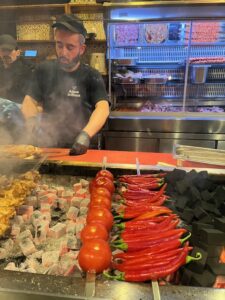
From neighborhood spots to cultural anchors
In districts like Kreuzberg, grillhouses became natural extensions of the neighborhood. Not bars, not cafés — something in between.
Places that feel alive from lunchtime to late evening, where you can walk in alone or with friends, and always experience the same warmth:
- the glow of the open grill,
- the rhythm of knives chopping fresh herbs,
- and that constant, comforting charcoal scent.
These places fit perfectly into Berlin’s lifestyle: relaxed, spontaneous, communal.
Cosy atmosphere
Restaurants represent the refined, grown-up chapter of Turkish charcoal dining in Berlin.
They are not “street food” and not nightlife spots — they are full-day, full-spirit establishments, what they offer is something Berlin always gravitates toward: realness, craftsmanship, dedication, and the warmth of shared food.

The flame that connects the city
A charcoal grill isn’t just a kitchen tool — it’s a symbol. It represents patience, tradition, and the idea that good things take time.
And in Berlin — a city that blends speed with slowness, boldness with understatement — this philosophy fits perfectly.

The editor tipp:
That’s why restaurants like Adana Grillhaus are more than places to eat. They’re part of how the city lives:unhurried, genuine, communal, and always close to the fire.
With our editorial recommendation — if you ever visit Berlin:
Wilmersdorf/Ku’damm:
Brandenburgische Straße 32.
Kreuzberg:
Skalitzer Straße 105
10997 Berlin, Germany

Related Articles


Related Articles